Massive Stars Forming Binary System Captured in Real Time: How ALMA Uncovered a 60-Year-Old Cosmic Collision
In an unprecedented astrophysical milestone that challenges textbook models of stellar evolution, international astronomers using the ALMA radio telescope array have directly observed massive stars forming a binary system in real time within protostellar system IRAS 07299−1651, revealing a chaotic cosmic collision that occurred just 60 years ago.
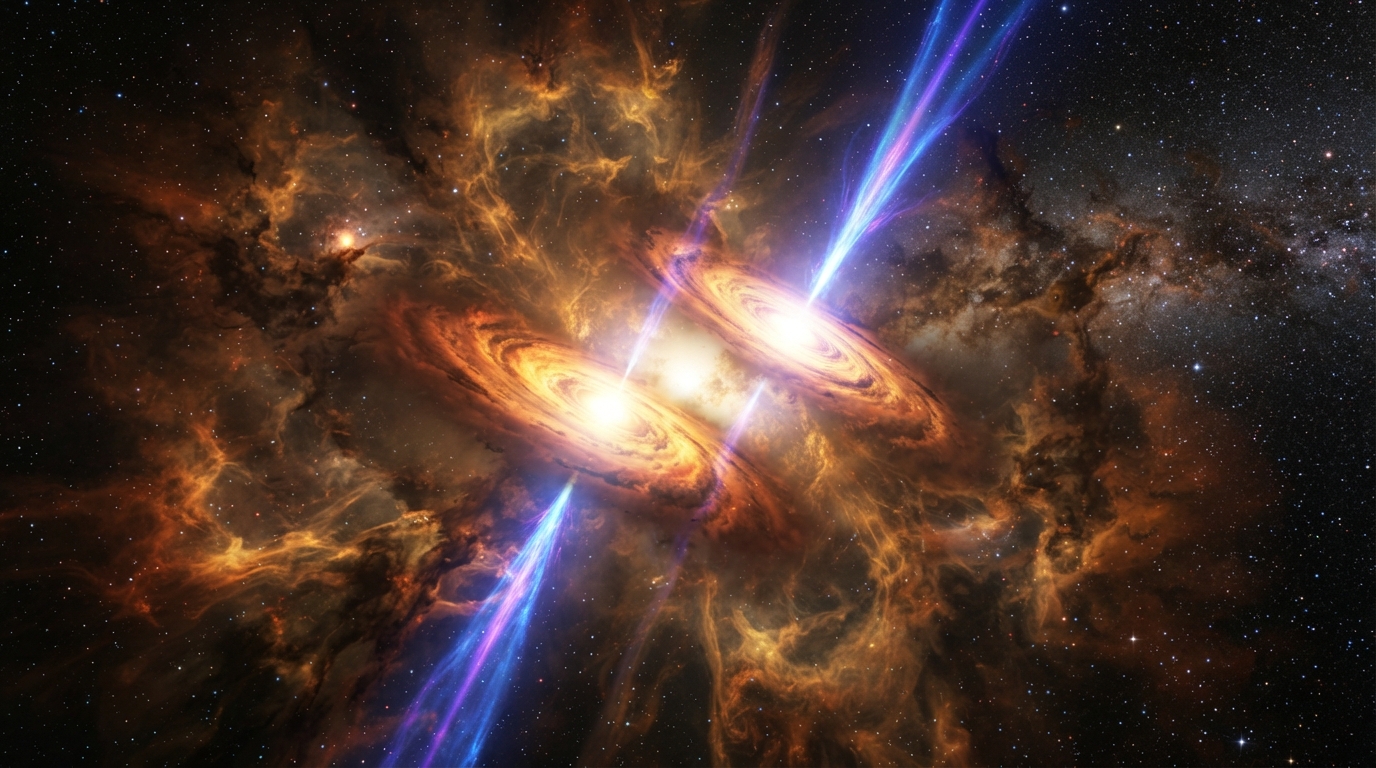
1.The Core Mystery: Why Massive Stars Form in Pairs
While our Sun exists in tranquil isolation, solitary stars are a rare anomaly across the broader Milky Way. Over 90% of massive stars—the cosmic heavyweights that forge heavy chemical elements and ultimately detonate as core-collapse supernovae—exist locked in binary or multi-star gravitational systems.
For decades, the standard astrophysical textbook paradigm relied almost exclusively on the "disk fragmentation" theory. This model assumed that a single, massive, rotating natal cloud of interstellar gas and dust naturally fragments into two separate stellar cores as it collapses. Under this classical scenario, both stars share a neat, coplanar orbit and rotate in parallel alignment like synchronized clockwork.
However, observing massive stars during their actual moment of gravitational birth has historically remained one of observational astronomy's steepest hurdles. Infant massive stars form deep inside hyper-dense envelopes of interstellar dust and gas that completely block visible light.
When an international team of astrophysicists turned the high-resolution eyes of the Atacama Large Millimeter/submillimeter Array (ALMA) toward the young protostellar nursery IRAS 07299−1651—located roughly 5,300 light-years away in the constellation Puppis—they discovered an unmistakable clue: the two rotating circumstellar accretion disks feeding each infant giant were tilted at sharp, conflicting angles to each other and to their common orbital trajectory. This dramatic geometric mismatch instantly shattered the classic single-cloud fragmentation model.
2.Reconstructing 3D Motion Across 8 Years of Multi-Wavelength Observations
To unravel why the stellar accretion disks were violently misaligned, researchers embarked on an intensive eight-year observation campaign (2016–2024), orchestrating a global fleet of cutting-edge ground and space telescopes:
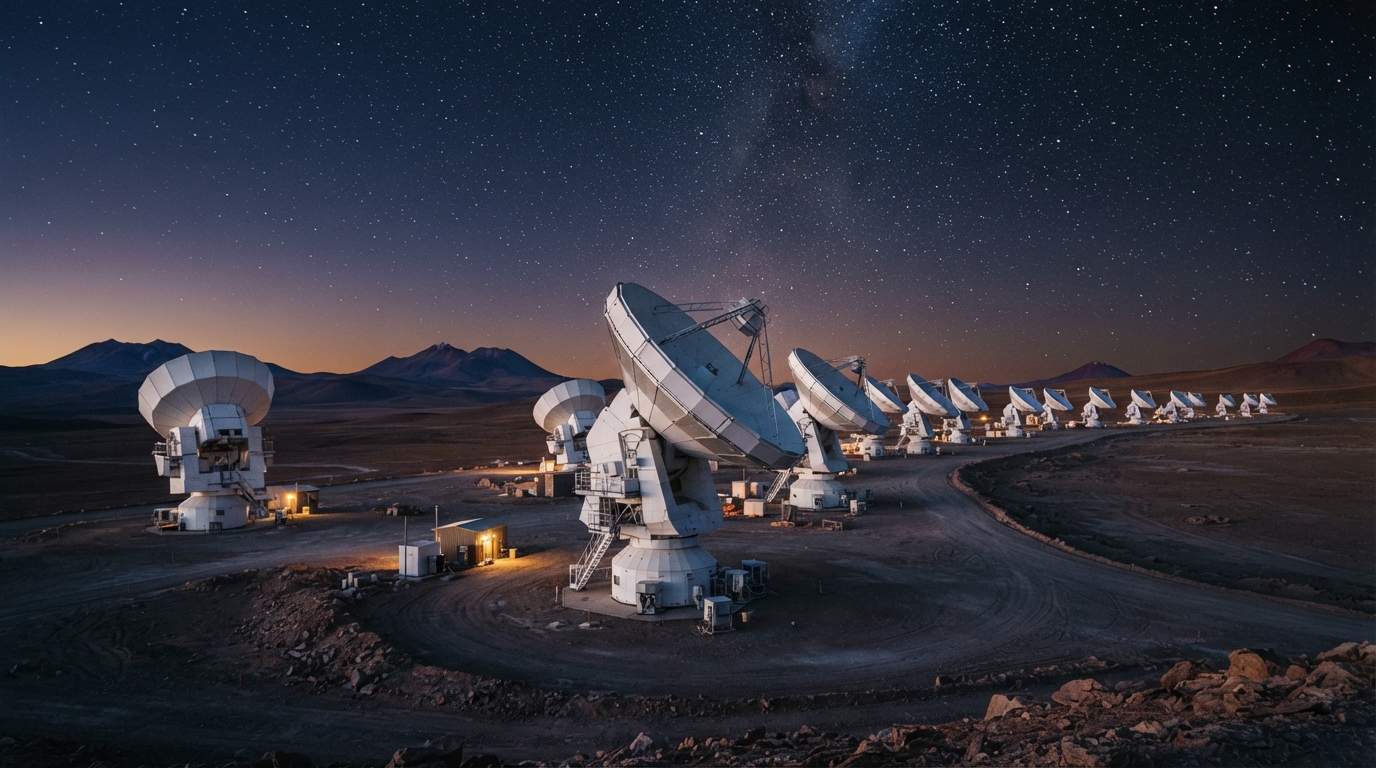
• Atacama Large Millimeter/submillimeter Array (ALMA): Operating in northern Chile's high-altitude Chajnantor plateau, ALMA pinpointed the sub-arcsecond proper motions of the two stellar cores. By analyzing millimeter-wavelength hydrogen recombination line (H30α) emissions, ALMA mapped the rapid rotational velocity of the inner ionized gas feeding each star.
• National Science Foundation’s Karl G. Jansky Very Large Array (VLA): Provided high-sensitivity radio continuum tracking at centimeter wavelengths, mapping the dense thermal plasma cores and magnetic jet launch zones.
• James Webb Space Telescope (JWST) & ESO's Very Large Telescope (VLT): Used high-resolution infrared instruments to pierce through hundreds of astronomical units of obscuring dust, capturing supersonic bipolar jets blasting away from both stellar poles at hundreds of kilometers per second.
By synthesizing proper motions, line-of-sight radial velocities (Doppler shifts), and bipolar jet orientations simultaneously, the research team reconstructed the first-ever three-dimensional orbital architecture of an assembling massive binary star system in real time.
3.The 60-Year-Old Encounter: How Independent Cores Formed an Eccentric Binary
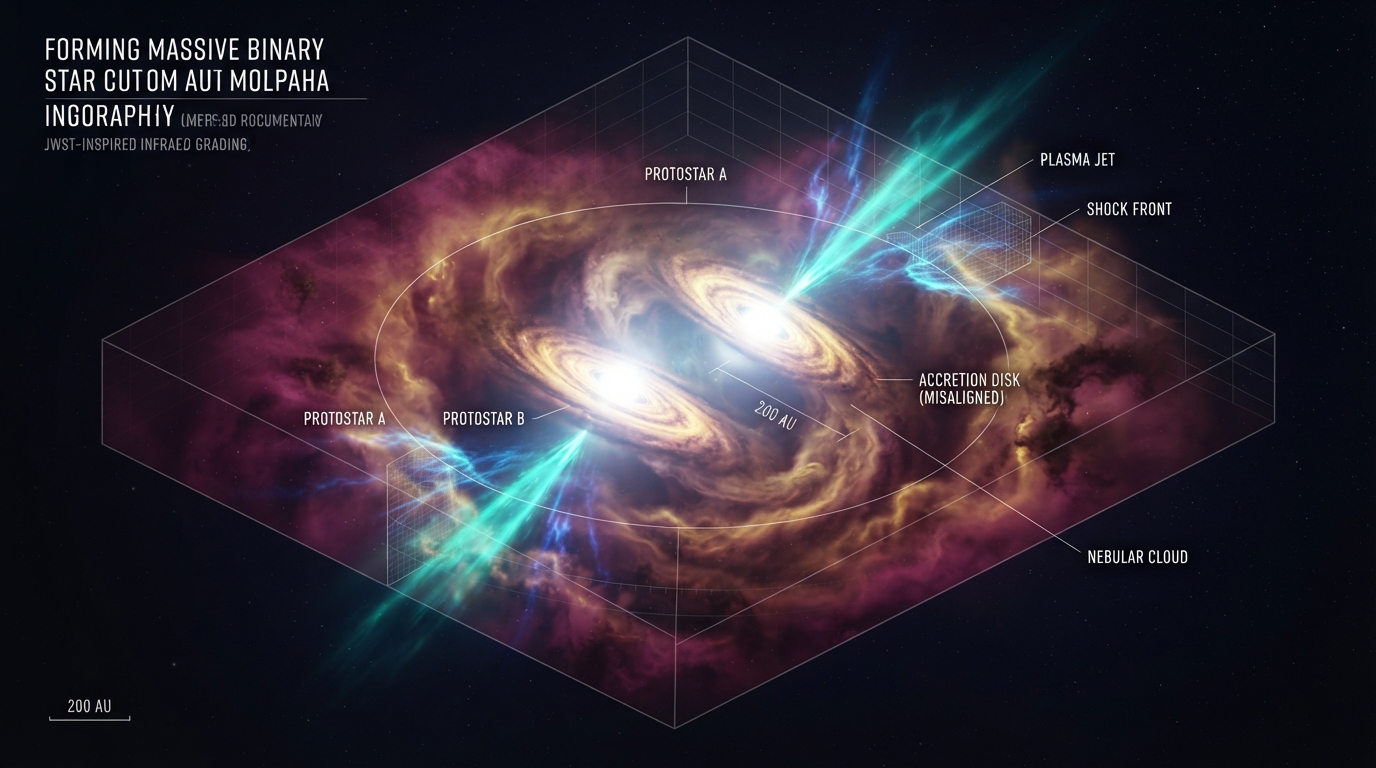
The 3D orbital reconstruction revealed a stunning discovery: rather than evolving peacefully together over millions of years, the two infant stars in IRAS 07299−1651 are locked in an extremely stretched, near-parabolic trajectory ($e \approx 1.0$) with a current separation of roughly 200 astronomical units (au)—ten times the distance between the Sun and Uranus.
Tracing their historical trajectory backward along the reconstructed orbit revealed that the two stars made their closest gravitational flyby (periastron) just around 60 years ago—a mere blink of an eye in cosmic timescales.
Each star formed independently in its own separate pocket of cold, dense molecular gas. As they drifted through the turbulent stellar nursery, a chance gravitational interaction drew them into a dramatic, near-collisional close encounter. The immense mutual gravity of the two giants redirected their paths, locking them into a chaotic gravitational tango.
Remarkably, despite the violent gravitational tidal forces experienced during the close flyby, both compact circumstellar accretion disks survived intact, continuing to funnel matter from the surrounding birth envelope onto the stellar surfaces.
4.Accretion Disks, High-Speed Plasma Jets, and Shock Dynamics
The multi-wavelength observations provided unprecedented insight into how massive protostars behave when subjected to extreme gravitational disturbances.
Each star is currently accumulating matter at an astounding rate of over $10^{-4}$ solar masses per year. As gas spirals inward along the tilted accretion disks, powerful magnetic fields channel a fraction of the matter into collimated, relativistic plasma jets.
Because the two accretion disks are oriented at conflicting angles, the resulting bipolar jets blast into the surrounding interstellar medium along wildly different axes. Where these supersonic shockwaves collide with cold ambient molecular clouds, they generate intense shock heating and complex molecular outflow patterns detectable in carbon monoxide (CO) and silicon monoxide (SiO) emissions.
This dynamic proves that massive star formation in crowded stellar clusters is far more chaotic, non-linear, and kinematically volatile than previously thought.
5.Unbound Slingshot or Permanent Pair: The System's Uncertain Astrophysical Fate
Because IRAS 07299−1651 currently rests on the razor's edge of a parabolic orbit—the mathematical boundary separating a permanently bound elliptical orbit from an unbound hyperbolic escape trajectory—astrophysicists are actively investigating whether the two stellar infants will remain partners for life.
Two potential evolutionary scenarios are currently under modeling:
1. Hydrodynamic Gas Drag & Permanent Binding: As the stars travel outward from their 1960s periastron, they must plow through the dense, viscous envelope of remaining gas and dust. This hydrodynamic friction acts as a natural brake, siphoning excess kinetic energy from the system. Over successive orbits, gas drag could circularize and tighten the orbit, forging a permanent, highly massive binary pair.
2. Hyperbolic Slingshot Ejection: If the system has sufficient residual kinetic energy to overcome gas drag, the two stars could slingshot away from each other on an unbound trajectory, continuing their lives as isolated runaway massive stars.
Continued high-precision astrometric monitoring with ALMA over the next decade will definitively clock the orbital deceleration, determining whether IRAS 07299−1651 settles into a lifelong binary or executes a cosmic parting of ways.
6.How This Milestone Transforms Stellar Evolution & Gravitational Wave Astronomy
The discovery of real-time massive binary star formation via dynamical capture carries profound implications for the wider astrophysics community:
• Rewriting Stellar Evolution Models: Stellar evolution codes must now incorporate dynamical core-mergers alongside classical disk fragmentation when predicting initial mass functions and binary population statistics in massive star clusters.
• Gravitational Wave Progenitors: Massive binary stars are the direct evolutionary ancestors of binary black holes and neutron star mergers. Understanding how these giants pair up early in their lifecycles provides vital boundary conditions for predicting gravitational wave merger rates detected by ground-based detectors like LIGO, Virgo, and KAGRA, as well as future space-based observatories like LISA.
• Chemical Enrichment of the Early Universe: Because massive stars synthesize heavy elements like carbon, oxygen, iron, and gold before seeding them across galaxies through supernova explosions, determining how binary dynamics alter their lifespans sheds new light on the chemical evolution of galaxies from the cosmic dawn to the modern epoch.
Key Facts: Traditional Binary Formation vs. IRAS 07299−1651 ALMA Observations
Direct side-by-side comparison contrasting traditional textbook disk fragmentation models with the newly discovered core-merger dynamical encounter.
| Astrophysical Parameter | Traditional Textbook Model | IRAS 07299−1651 Observed Reality |
|---|---|---|
| Primary Formation Pathway | Single spinning cloud disk fragmentation | Independent core dynamical capture / core merger |
| Orbital Eccentricity (e) | Circular to moderate ellipse (e < 0.4) | Extreme near-parabolic trajectory (e ≈ 1.0) |
| Circumstellar Disk Alignment | Coplanar and parallel alignment | Sharply tilted and mutually misaligned (conflicting angles) |
| Time Since Closest Approach | Gradual orbital settling over millions of years | Closest periastron flyby occurred just ~60 years ago |
| Current Separation Distance | Varies based on cluster density | ~200 Astronomical Units (au) (~10× Sun-Uranus distance) |
| Accretion Disk Stability | Smooth, symmetric matter flow | Turbulent disks survived extreme tidal shearing forces |
| Stellar Mass Accretion Rate | Steady laminar infall | Hyper-accelerated burst accretion (>10⁻⁴ M☉/year) |
Frequently Asked Questions (FAQ)
Q1: How are massive stars forming binary systems according to the new Nature Astronomy study?
The study demonstrates that massive binary star systems can assemble via a dynamic 'core-merger' process—where two independent infant stars forming in separate gas nurseries undergo a chance near-parabolic gravitational encounter that binds them into an eccentric binary system.
Q2: Why are binary star systems so critical in modern astrophysics?
Over 90% of massive stars across the universe belong to binary or multiple systems. These pairs drive core-collapse supernovae, enrich the interstellar medium with heavy elements, and ultimately merge as binary black holes or neutron stars, creating gravitational waves detected by LIGO and Virgo.
Q3: What telescopes and instruments made the IRAS 07299−1651 discovery possible?
The primary 3D orbital mapping was conducted using the Atacama Large Millimeter/submillimeter Array (ALMA) in Chile, supported by radio observations from the NSF's Karl G. Jansky Very Large Array (VLA), and high-resolution infrared imaging from the James Webb Space Telescope (JWST) and ESO's Very Large Telescope (VLT).
Q4: Will the two infant stars in IRAS 07299−1651 remain permanently bound?
The infant stars currently sit on the threshold between an elliptical bound orbit and an unbound escape trajectory. Astrophysicists expect hydrodynamic gas drag from the surrounding natal cloud to drain excess kinetic energy, likely locking them into a permanent binary over cosmic time.
Editorial Standards & Fact-Checking Transparency
This report adheres to Daily Science News' rigorous academic guidelines. All claims are verified against primary scientific literature from institutions including NASA, ESA, CERN, and peer-reviewed journals. Supervised by Dulaksha Sandeepa. Questions or corrections? Contact contact@sciencenewshub.click.